The Narco Submarine
A homemade submarine packed with cocaine changed how the world understood the scale of drug trafficking - and who gets blamed for it.

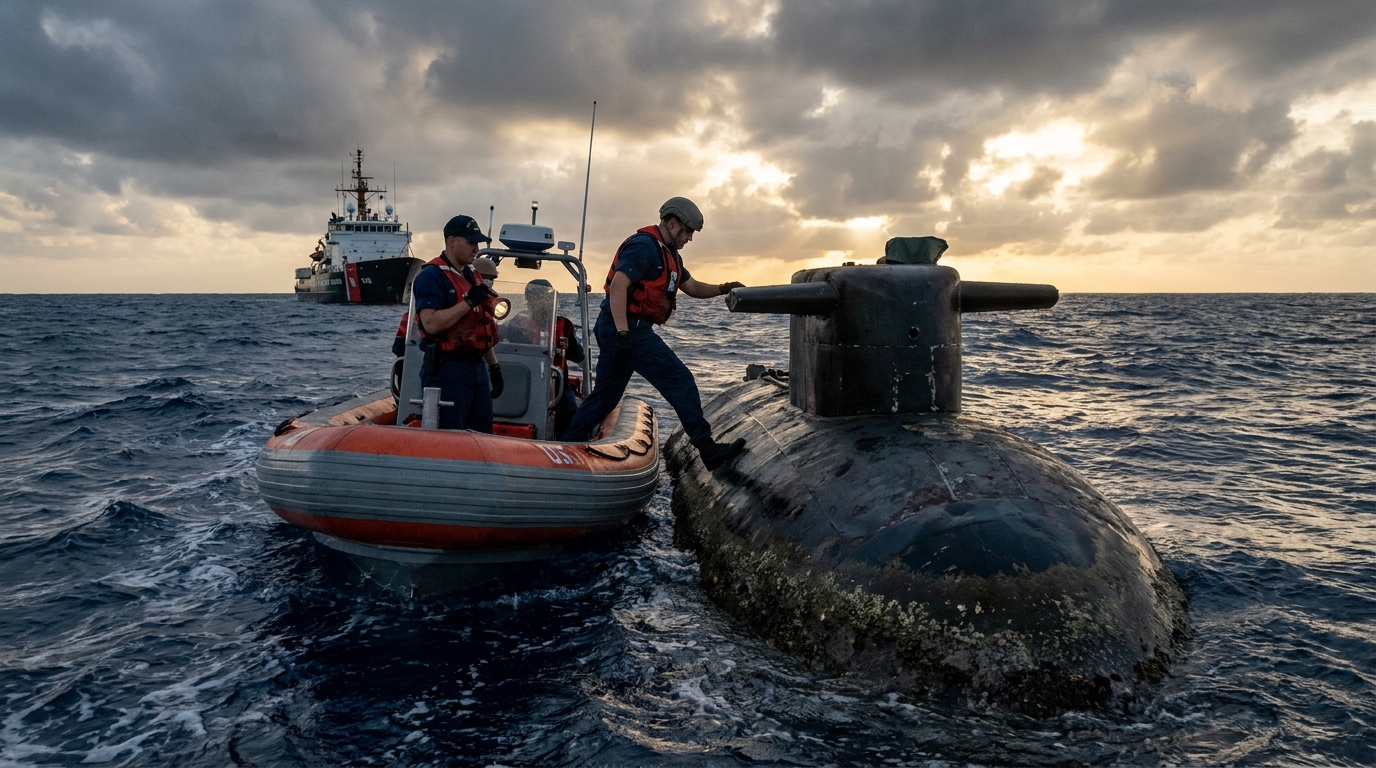
The vessel was sixty feet long, diesel-powered, and built from fiberglass in a jungle clearing somewhere along the Colombian coast. It had a crew of four. It carried three tons of cocaine. It traveled just below the surface of the Pacific, leaving almost no radar signature, running dark. By the time the U.S. Coast Guard and Colombian authorities intercepted it in July 2008, it had already made the drug-trafficking world understand that semi-submersibles were not a gimmick - they were the new normal.
What the interception did not do was change the conversation about why those submarines exist in the first place.
Built by Hand, Paid for by Demand
The engineering inside that boat was not imported. Nobody shipped in specialists from a submarine-building nation. Colombian traffickers developed these vessels over years of improvisation, responding to increased aerial and maritime surveillance by going underwater. The boats range in sophistication - some are little more than fiberglass tubes with an engine bolted in, others have more elaborate navigation systems and crew quarters. What they all share is the ability to evade the kind of detection that took down go-fast boats a decade earlier.
The particular vessel seized in 2008 was carrying cocaine with a street value estimated at $187 million. The four crew members - Ecuadorans and Colombians - were arrested. The boat was photographed extensively and shared across media. U.S. drug enforcement officials described it as a significant seizure.
It was. It also represented a fraction of the estimated 500 to 600 metric tons of cocaine trafficked from South America into the United States annually.
Who Gets Blamed
The policy conversation that follows every major seizure follows a familiar script. The focus lands on the producing countries - Colombia, Peru, Bolivia - and the trafficking organizations that move the product. The focus rarely lands on the consuming country that creates the market or the financial institutions that launder the proceeds.
The U.S. Department of Justice has estimated that between $18 billion and $39 billion in drug money is laundered in the United States each year. Some of it moves through formal banking channels. None of the major U.S. banks have faced criminal charges for their role in narco-financing, though several have paid civil fines.
The families of the traffickers who built that submarine in a jungle clearing - Colombians, Ecuadorans, some of them likely from communities that had no economic alternative to participating in the trade - received no such consideration.
What the Submarine Tells You
The sophistication of the vessel is itself a message. Traffickers do not build semi-submersibles because they are easy or cheap. They build them because the demand for cocaine in the United States is so consistent and lucrative that the economics justify the investment. You do not spend millions developing submarine technology for a market that might disappear.
This is the part of the story that gets skipped in most coverage. The narco submarine is presented as a story about criminal audacity, about the ingenuity of bad actors, about the relentless challenge faced by law enforcement. It is rarely presented as a story about what it means to live in a nation that consumes the most cocaine in the world and then wages a war on the countries that produce it.
Latino communities - Colombian, Ecuadoran, Mexican, Caribbean - are caught in the middle of this in ways that are almost never acknowledged. Their home countries are militarized by U.S.-funded eradication programs. Their immigrants in the United States are surveilled and deported in enforcement regimes that claim to target traffickers but sweep up workers. The violence generated by the trade falls heaviest on working-class communities in Bogota, Medellin, and Cali.
The men on that submarine faced federal drug charges. The demand that put them there faced no charges at all.
The Story Continues
By 2009, U.S. officials estimated that semi-submersibles were responsible for an increasing share of cocaine trafficking. The technology kept improving. Crews learned from each interception. Law enforcement budgets increased. Eradication programs in Colombia destroyed thousands of acres of coca plants, which then regrew or relocated.
The submarine was seized. The trade continued. The story of who bears the cost of that continuation was not the story most Americans read in the summer of 2008.
It is, however, the story that matters.